In the last blog post, we explored the growing wave of high-protein products filling supermarket shelves and questioned whether these foods are truly worth the hype. Naturally, the next step in the conversation is a much simpler, yet far more important question: how much protein do we actually need in a day? It is one of the most common questions in nutrition, but much like many topics within the field, the answer is not entirely straightforward. Protein requirements can vary depending on factors such as activity levels, training goals, age, and overall health, which is why discussions around protein intake often become more nuanced than social media headlines would suggest.
What protein actually does — and why the RDA is only a floor
The first part in answering this question is understanding the complex role of protein in our human bodies. Protein acts as one of the body’s main building materials, with its small components named amino acids transported around the body to support the maintenance and repair of tissues. In the context of muscle, these amino acids build up muscle proteins which constantly turnover throughout the day. This process is essential to the adaptations taking place as a result of movement and exercise.
Current Recommended Dietary Allowances (RDAs) suggest consuming 0.8 grams of protein per kilogram of body weight per day (Panel on Macronutrients, 2005), meaning that someone weighing 75 kilograms would aim for around 60 grams daily. At first glance, this may sound like the “ideal” target, but it is important to understand what the RDA is actually designed for. The recommendation exists primarily to prevent deficiency across population groups rather than to optimise muscle growth, athletic performance, recovery, or body composition (Jeukendrup & Gleeson, 2023). In other words, the RDA reflects the minimum amount needed for general health, not necessarily the amount that supports optimal physical adaptation.
From “avoiding deficiency” to optimising performance
Once this distinction has been made, the conversation surrounding protein moves from simply “avoiding deficiency” to optimising muscle performance. Research is now increasingly focused on identifying intake levels that may optimise muscle adaptation and whole-body protein metabolism rather than simply preventing inadequate intake. Emerging work using newer methodologies, such as the Indicator Amino Acid Oxidation (IAAO) technique, suggests that intakes closer to 1.2 g/kg/day may better support whole-body protein anabolism than the current RDA (Malowany et al., 2026).
From a muscle-specific perspective, the evidence becomes even more interesting. Research consistently shows that 0.8 g/kg/day is likely insufficient to maximise adaptations to resistance training, such as increases in muscle mass and strength. Intakes of around 1.6 g protein/kg/day appear to be a more effective target for individuals looking to optimise training adaptations. Evidence from a comprehensive meta-analysis further suggests that protein intakes up to approximately 2.2 g/kg/day are a prudent approach to maximise resistance training adaptations (Morton et al., 2018). Going back to the earlier example, a 75-kilogram individual aiming to support gym training gains may therefore benefit from consuming somewhere between 120 and 165 grams of protein per day.
There is no single perfect number
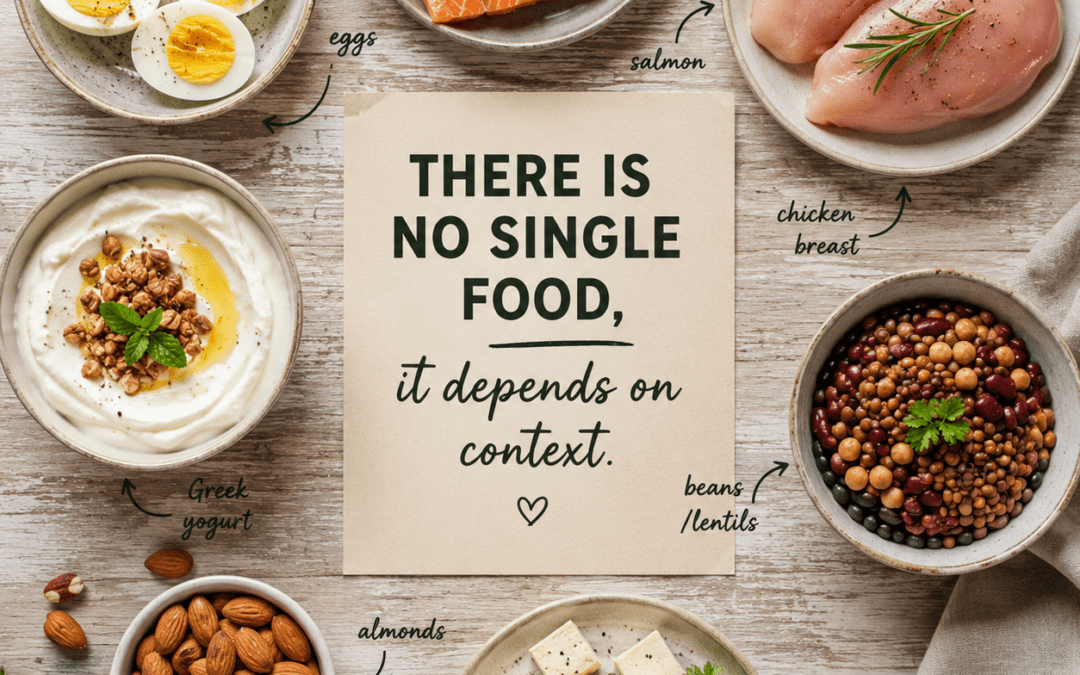
At this point, it would be easy to look for one perfect number to aim for, but nutrition rarely works that way. The “optimal” protein intake depends heavily on the individual’s context. Training type, weight, and performance goals can all influence protein requirements. Even age can influence how our body responds to protein intake, something we will delve into further in a future blog piece. That is partly why protein discussions can become confusing online: recommendations tend to be categorical, but are actually highly individualised.
Still, to provide a more definitive answer based on the larger body of research in this topic, aiming for around 1.6 g/kg/day appears to be a practical and evidence-based target for many physically active individuals wanting to support performance, recovery, and body composition goals.
The bottom line
Ultimately, the most useful takeaway is not that everyone should adopt high-protein intakes, but rather that not all recommendations in nutrition are built the same. Understanding the distinction is important because there is rarely one perfect number when it comes to what we eat. Each of us should aim to find the approach that best fits our lifestyle.
How much protein do you need?
A quick estimate based on your weight, age, and goal. Refined further in a coaching consultation.
Want help applying this to your daily eating? A 15-minute discovery call is the easiest next step.
Book a free discovery callThis estimate is based on general guidelines for active adults (Morton et al., 2018; Phillips et al., 2021). Individual needs vary based on training intensity, body composition, medical conditions, and other factors. For pregnant or breastfeeding women, athletes in extreme weight cuts, or anyone with kidney conditions, consult a qualified professional before adjusting protein intake.
References
Jeukendrup, A., & Gleeson, M. (2023). Sport nutrition (4th ed.). Human Kinetics.
Malowany, J. M., West, D. W. D., Williamson, E., Volterman, K. A., & Moore, D. R. (2026). Protein requirements for skeletal muscle and whole-body protein metabolism in healthy young men and women determined by the indicator amino acid oxidation technique. The American Journal of Clinical Nutrition.
Morton, R. W., Murphy, K. T., McKellar, S. R., Schoenfeld, B. J., Henselmans, M., Helms, E., Aragon, A. A., Devries, M. C., Banfield, L., Krieger, J. W., & Phillips, S. M. (2018). A systematic review, meta-analysis and meta-regression of the effect of protein supplementation on resistance training-induced gains in muscle mass and strength in healthy adults. British Journal of Sports Medicine, 52(6), 376–384. https://doi.org/10.1136/bjsports-2017-097608
Panel on Macronutrients, Subcommittees on Upper Reference Levels of Nutrients and Interpretation and Uses of Dietary Reference Intakes, & Standing Committee on the Scientific Evaluation of Dietary Reference Intakes. (2005). Dietary reference intakes for energy, carbohydrate, fiber, fat, fatty acids, cholesterol, protein, and amino acids. National Academies Press. https://doi.org/10.17226/10490