

“Carbohydrates are the main source of energy during moderate-to-high intensity exercise” is a common sentence starring in exercise science papers that tackle energy requirements during exercise. I have read this sentence a lot in my academic years, even used in some of the papers I wrote. The given statement results from a century of carbohydrate metabolism research, starting back in the 1920s with investigations on the physiology of runners at the Boston marathon (Gordon et al., 1925). So, let’s delve into why our bodies use more carbohydrates when we exercise.
From desk job to Tour de France: same body, different demands
In a previous blog post, I argued that carbohydrates can be a part of every individual’s lifestyle — although the demands and needs of an office worker significantly differ from those of a Tour de France cyclist. While office work is demanding and the brain predominantly uses glucose as an energy source (Jensen et al., 2020), the metabolic demands of exercise are much more taxing.
During exercise, most physiological variables such as heart and breathing rate are significantly increased. These increases demand a higher turnover of energy. And here is where we meet the energy currency of our body: adenosine triphosphate (ATP). Every time a molecule of ATP is broken down, energy is released and more work can be performed. Carbohydrates contribute to energy provision by generating ATP, supporting our tissues and organs in meeting the demands we require of them.
The oxygen constraint: why carbs beat fats at high intensity
Carbohydrates, whether simple or complex, are broken down following consumption to their smallest unit: glucose. Glucose travels throughout the bloodstream to sites where it is needed — such as the muscle during exercise. Within muscles, glucose is further broken down aerobically (in the presence of oxygen) or anaerobically (without oxygen) to obtain ATP.
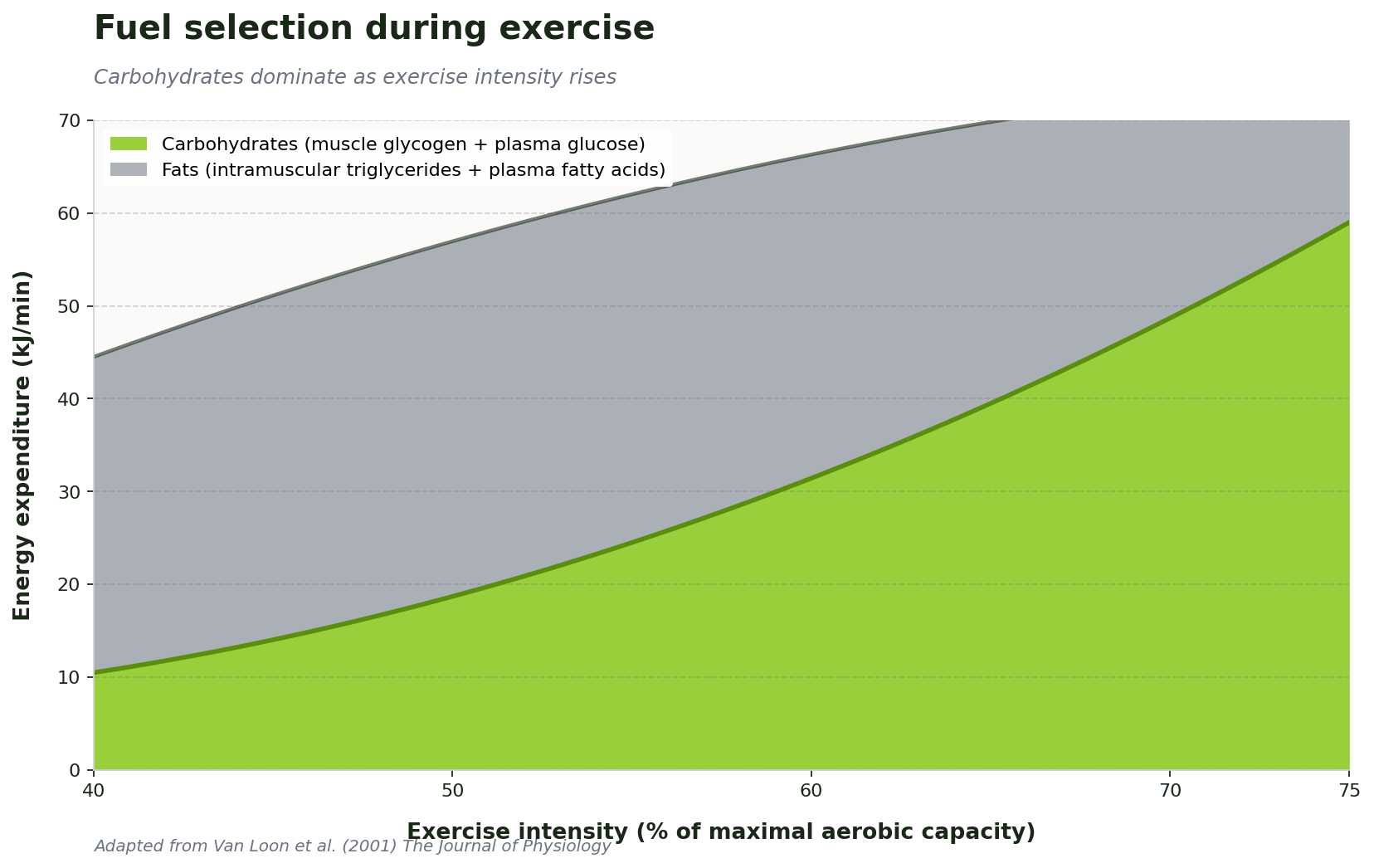
With increasing exercise intensity, our body requires more and more ATP, but it struggles to keep up with oxygen demands. And this is where carbohydrates really earn their rank as the preferred substrate during exercise, compared to fats. Carbohydrates require less oxygen to produce the same amount of energy (Krogh & Lindhard, 1920). During intense exercise — when oxygen availability becomes a limiting factor — the body shifts to the energy source that allows it to better keep up with the demands put on it. Consequently, the muscles rely more on carbohydrates as exercise intensity increases (Van Loon et al., 2001), a shift illustrated in the figure below.
What this means for race-day performance
These mechanistic changes result in exercise performance differences as well. Studies investigating differences in performance measured via race times have given the advantage to diets containing ample carbohydrates (Burke et al., 2017). This does not mean that any of you, readers, should necessarily start loading up on carbohydrates for your runs every single time. As always, there is more nuance in training and nutrition. Maybe even more importantly, there is more to life than exercise performance.
Carbohydrates have their role in your lifestyle and that role is magnified during hard training days. Still, proteins (which we have discussed already) and fats (which we will have the chance to discuss soon) are still part of the essential needs of our bodies each and every day.
So — should everyone increase their carbohydrate intake?
Likely not. Their role in our lives depends on the demands we put on our bodies. If you are a high-level athlete preparing for a competition, adding a bagel with jam to your breakfast could be valuable in your nutrition strategy. Otherwise, you may just enjoy it every once in a while, as part of your morning meal.
At the end of the day, carbohydrates are another nutritional tool, with their value coming from how these fit within your lifestyle — supporting your intense training or providing energy throughout the day.
📚 This is article #6 in our macronutrient series. Catch up on the others: Are carbohydrates the problem? · Animal vs plant-based protein · How much protein should we consume?
References
Burke, L. M., Ross, M. L., Garvican-Lewis, L. A., Welvaert, M., Heikura, I. A., Forbes, S. G., Mirtschin, J. G., Cato, L. E., Strobel, N., Sharma, A. P., & Hawley, J. A. (2017). Low carbohydrate, high fat diet impairs exercise economy and negates the performance benefit from intensified training in elite race walkers. The Journal of Physiology, 595(9), 2785–2807.
Gordon, B., Levine, S. A., & Wilmaers, A. (1925). Observations on a group of marathon runners with special reference to the circulation. Archives of Internal Medicine, 36(4), 425–432.
Jensen, N. J., Wodschow, H. Z., Nilsson, M., & Rungby, J. (2020). Effects of ketone bodies on brain metabolism and function in neurodegenerative diseases. International Journal of Molecular Sciences, 21(22), 8767.
Krogh, A., & Lindhard, J. (1920). The relative value of fat and carbohydrate as sources of muscular energy. Biochemical Journal, 14(3-4), 290–363.
Van Loon, L. J. C., Greenhaff, P. L., Constantin-Teodosiu, D., Saris, W. H. M., & Wagenmakers, A. J. M. (2001). The effects of increasing exercise intensity on muscle fuel utilisation in humans. The Journal of Physiology, 536(1), 295–304.